On January 25, 2026, the world’s eyes were fixed on the Taipei skyline.
Legendary American free solo climber Alex Honnold completed a historic ascent of Taipei 101, scaling the 508-meter skyscraper without ropes or safety protection in just 91 minutes, as tens of millions of viewers watched via live broadcast. Behind this unprecedented feat were 75 days of drone reconnaissance and roped training, as well as widespread curiosity about the climber’s unconventional fuel source—his “99% plant-based diet.” How does the star of the Oscar-winning documentary Free Solo sustain peak performance on beans and grains alone?
Honnold had originally planned to make the climb on January 24, but rain forced a delay until the morning of the 25th. Despite strong winds of Beaufort scale 5 to 6 at high altitude in Taipei’s Xinyi District, he remained calm and composed, relying on extraordinary muscular endurance to overcome the tower’s distinctive segmented, bamboo-like structure, once again rewriting the limits of human athletic achievement.
According to sources cited by The New York Times, Honnold earned approximately USD 500,000 (about NTD 15.7 million) for the challenge. While modest compared with the earnings of professional sports superstars, Honnold emphasized that he climbed not for money, but for “dreams and challenges.”
His team deployed drones to circle the tower at high altitude, capturing images from multiple angles to help him memorize movement sequences and precise hand placements. Prior to the climb, Honnold conducted multiple roped practice sessions on Taipei 101, familiarizing himself with every railing, joint, and crevice of the 508-meter giant.
Central Weather Administration forecaster Cheng Chieh-jen noted that temperatures at elevation on the morning of the climb were only 17–19°C, with force-6 gusts strong enough to sway large trees and make umbrellas difficult to hold. Under such unstable wind conditions, Honnold maintained balance using only his fingers and arms, showcasing an exceptionally lean physique and remarkable muscular stability.
After losing his father at the age of 19, Honnold became acutely aware of life’s fragility and committed himself fully to climbing. In 2017, he completed a 914-meter free solo ascent of El Capitan, a feat that earned Free Solo the Academy Award for Best Documentary Feature and cemented his legendary status in the solo climbing world. He once said, “If you fall, it’s because you can’t do it. You just have to practice until you can.”
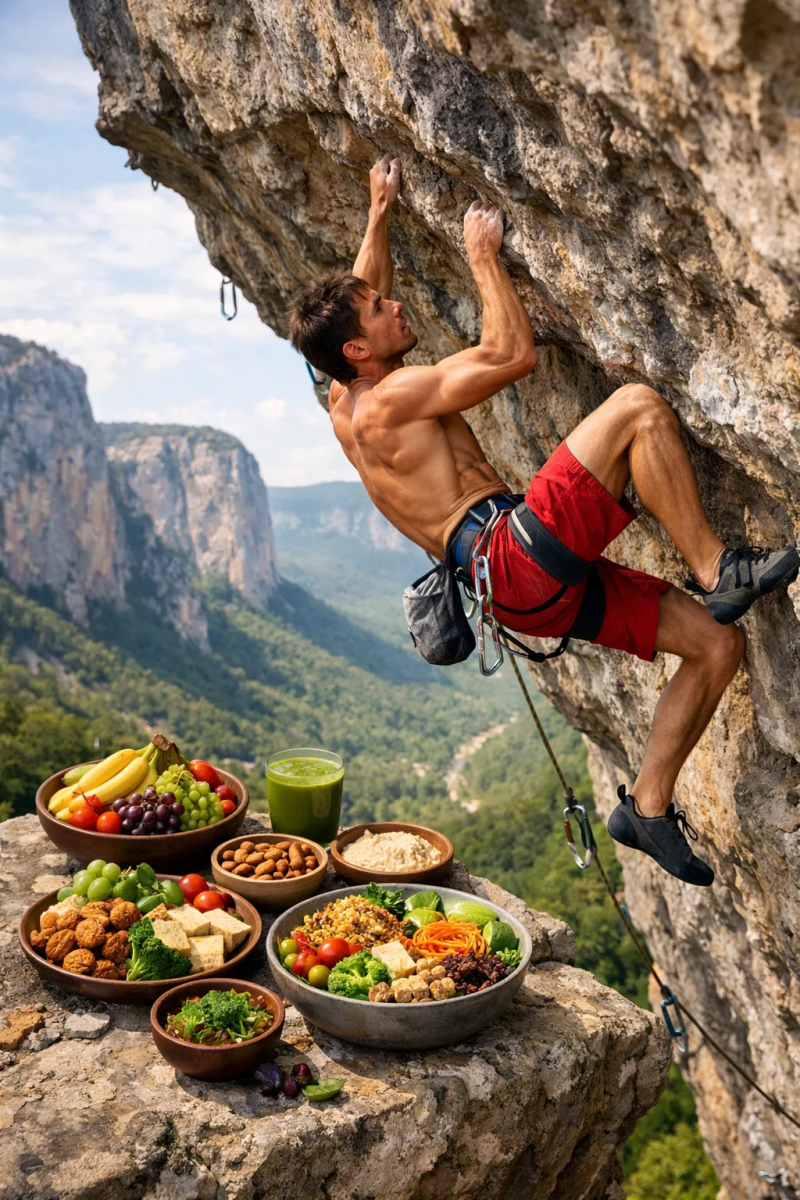
What has astonished the nutrition community is that the fuel behind Honnold’s extreme physical output is a “99% plant-based diet.” Family medicine physician Hsu Shu-hua explains that maintaining peak athletic performance on a vegetarian diet requires mastering three key principles:
-
Complementary legumes and grains: Combining plant proteins to compensate for missing amino acids and form complete proteins.
-
High nutrient-density foods: Choosing natural ingredients that promote rapid muscle repair.
-
Omega-3 healthy fats: Sourced from seeds such as flaxseed and chia seeds to reduce inflammation and maintain joint flexibility.