
Why Does Your Engine Feel Underpowered on Climbs? Unveiling HTHS: The Secret Power Code Beyond Viscosity Ratings
Many drivers face a common frustration: their car feels light and fuel-efficient during daily commutes, but when hitting long inclines, carrying heavy loads, or overtaking at high speeds, the engine sound becomes harsh, the pedal feels "heavy," and there is a noticeable lag in power delivery.
The core reason often isn't that you chose the wrong viscosity grade (like 0W-20 or 5W-30), but rather lies in a critical performance metric: HTHS (High Temperature High Shear).
1. Viscosity is the "Skin," HTHS is the "Core"
When choosing motor oil, most people look at the SAE viscosity rating first.
-
Low-Temperature Rating (0W/5W): Determines flow speed during cold starts.
-
High-Temperature Rating (20/30/40/50): Represents the Kinematic Viscosity at 100°C.
However, these ratings measure oil in a state of "calm flow." Inside a working engine, pistons reciprocate hundreds of times per second, subjecting the oil to immense tearing forces (shear stress). This is where HTHS comes in.
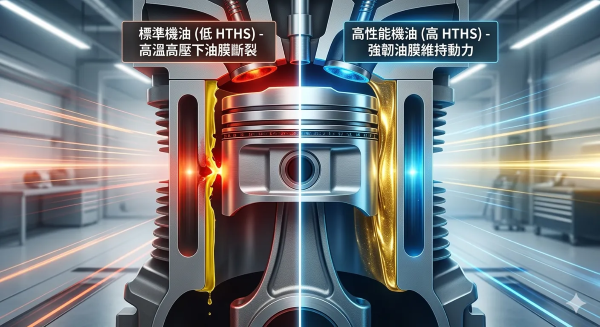
HTHS measures oil film strength and toughness at 150°C, simulating the extreme pressure of high-RPM operation. If the HTHS value is insufficient, the oil film will thin out or rupture under high heat and pressure—even if the viscosity grade is correct—causing power to be lost to frictional heat.
2. How HTHS Performs in Real-World Conditions
Contrary to the myth that HTHS only matters on the racetrack, it plays a decisive role in three everyday driving scenarios:
-
Traffic Jams: Protecting the Oil Film Under Heat Soak In stop-and-go traffic, the lack of airflow causes engine bay temperatures to skyrocket (Heat Soak). As the oil thins, frequent starts put immense pressure on pistons and bearings. High HTHS oil maintains sufficient film thickness even at low flow rates, preventing micro-wear from metal-to-metal contact.
-
Long Inclines and Heavy Loads: Resisting Gravitational Potential Energy Climbing requires sustained high torque, causing temperatures in the oil pan and piston rings to soar. High-quality, high-HTHS oil reduces "friction-induced heat." This is why an engine using a robust oil maintains steady RPMs and feels "responsive" on a climb, rather than just producing a strained engine roar.
-
High-Speed Overtaking: The Test of Instant High Shear Suddenly flooring the accelerator pushes internal shear stress to its peak. Oil with superior shear stability ensures that molecular chains do not break, maintaining a linear and solid sense of power delivery.
3. Debunking the Myth: Flow Cooling vs. Film Strength
There is a common saying: "Low viscosity oil (like 0W-20) flows faster, so it cools better." This is only half true.
While faster flow aids in heat exchange, if the oil film strength is inadequate, the heat generated by friction will far exceed the heat carried away by the oil. The ideal solution is to stick to the manufacturer’s recommended low viscosity (for flow and fuel economy) but choose a premium oil that offers high HTHS and advanced anti-wear additives.
By using chemical reinforcements—such as Zinc, Molybdenum, or MPZ technology—to enhance boundary lubrication, the oil provides a powerful sliding defense even when the physical oil film is squeezed to its absolute limit.
4. How to Choose a Truly "Powerful" Oil
If you seek solid power feedback across all driving conditions, keep these principles in mind:
-
Look Beyond the Grade: Check the HTHS data of the oil. Performance-oriented oils typically disclose this parameter.
-
Prioritize Shear Stability: Opt for high-quality base oils (such as PAO or Esters) to ensure the oil does not suffer "permanent shear loss" after prolonged high-load use.
-
Chemical Reinforcement: Products rich in anti-wear elements like ZDDP (Zinc) can fill the defensive gaps of the physical oil film under extreme heat.
Motor oil is more than just lubrication; it is a "liquid component" of your engine. Choosing a high-HTHS product provides your engine with the toughest possible foundation for power.