Why Climbing is the Ultimate "Pressure Test" for Motor Oil
Many drivers believe that motor oil is simply for "lubrication." However, under extreme conditions like the long, grueling inclines of a highway—where high speed, high temperature, and high pressure converge—motor oil plays a far more critical role: Structural Support and Airtight Sealing.
🚩 The "Physical Collapse" Under High Pressure
When maintaining a steady 108 km/h on a steep incline with a half-depressed throttle, the combustion pressure within the engine multiplies. Under these conditions, standard "middle-of-the-road" certified oils often reach their physical limits:
-
Oil Film Shearing: Under the combined assault of intense heat and pressure, the oil molecules are "squeezed" away like water.
-
Pressure Leakage: Once the oil film thins, the "airtight seal" between the piston rings and the cylinder wall fails. Combustion pressure leaks into the crankcase (Blow-by), causing the engine note to become sharp and strained, while the power output feels hollow and unresponsive.
🛡️ The Data Speaks: Torco’s Compression Rigidity
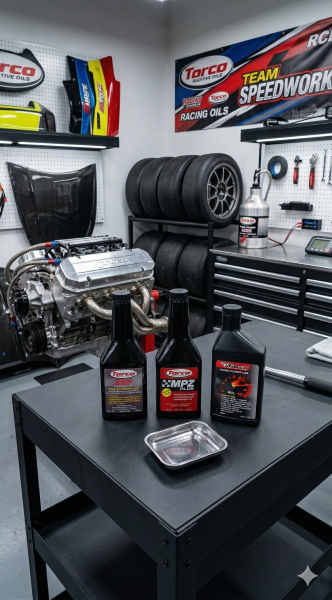
The 3.7 HTHS (High Temperature High Shear) rating on the Torco data sheet isn't just a vanity metric—it is the core strength required to handle extreme pressure.
-
3.7 mPa-s Hydraulic Support: While standard fuel-efficient 30-weight oils hover around a 3.0 HTHS, Torco pushes this to 3.7. This means that under the peak pressure of a climb, the oil acts as a "physical gasket," stubbornly maintaining the gap. When the pressure doesn't leak, the push remains solid.
-
7% NOACK Basestock Resilience: The greatest fear during a high-temp climb is the oil "cooking" and thinning out. A remarkably low 7% Evaporation Loss (NOACK) ensures that the oil maintains its "tight" physical integrity. It won't rapidly liquefy due to heat, locking in the physical seal from the start of the climb to the summit.
⚡ Reinforced Sealing: The Triple Defense of ZEP + MPZ + RCL
Beyond the base oil, the addition of ZEP, MPZ, and RCL constructs an active defense network within the engine:
-
ZEP (Physical Reinforcement): Specifically targets high-pressure critical points, strengthening the oil film's resilience so that piston rings operate as if on precision-guided rails.
-
MPZ (Chemical Friction Reduction): Establishes a chemical bond on metal surfaces. Even if climbing pressure manages to break the physical oil film, the MPZ layer provides ultra-low friction sliding to prevent "dry scuffing."
-
RCL (Upper Cylinder Sealing): Enters the combustion chamber from the top, optimizing the seal of the valves and the upper piston area for a total-chamber seal.
📈 Conclusion: Power Derives from Absolute Airtightness
Maintaining a constant 108 km/h on a steep grade isn't just a test of fuel economy—it’s a test of Engine Integrity.
When physical airtightness reaches its peak, you no longer feel the engine’s strained roar; instead, you feel a dense, powerful surge of torque. This proves that with a strong enough physical foundation, even an engine with 200,000 km can exhibit an unshakeable toughness that refuses to buckle under pressure.
We aren't just maintaining the engine; we are optimizing its physical architecture.
.png)