Physical Air-Tightness: Rediscovering the Lost "Synergy" Between Engine and Transmission
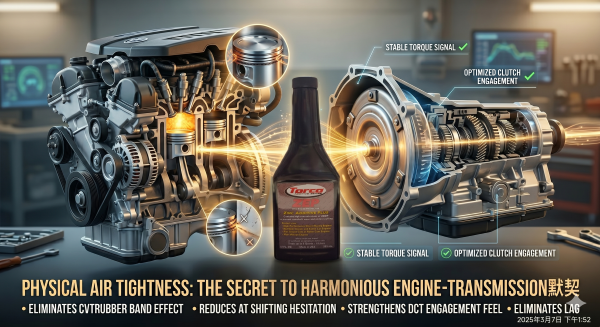
In the world of automotive tuning and maintenance, we often treat the engine and transmission as two separate entities. However, seasoned drivers understand that they are a single, interconnected organism. Complaints about sluggish transmission response, shift shock, or jerky power delivery often miss the mark; the root cause is frequently not the gearbox itself, but rather the engine's physical air-tightness.
By optimizing air-tightness with high-concentration physical strengthening agents like #TorcoZEP, you will find that regardless of your transmission type, the entire drivetrain "wakes up" and becomes exceptionally responsive.
I. Transmission Logic Depends on the Engine’s "Core Strength"
The Transmission Control Unit (TCU) determines when to shift or change gear ratios based on the engine's torque output signals.
When engine air-tightness is compromised, combustion pressure leaks through microscopic gaps in the piston rings, leading to "hollow" or inconsistent power delivery. In this state, the TCU receives vague and unstable torque signals, causing hesitation in its logical decision-making.
-
Strong Air-Tightness: Solid engine output provides clear signals, allowing the transmission to execute shifts decisively and crisply.
II. Comprehensive Evolution Across All Transmission Types
No matter what technology powers your vehicle, the solidity brought by improved air-tightness creates a positive chain reaction:
1. CVT (Continuously Variable Transmission): Eliminating the "Rubber Band" Effect
The most common criticism of CVTs is the lag where RPMs rise but the acceleration feels delayed. When air-tightness is improved, the engine releases ample torque at low RPMs. This significantly reduces the "slipping" sensation during belt adjustments, making acceleration feel direct and immediate.
2. AT (Automatic Transmission): Solving "Shift Logic Hesitation"
In stop-and-go city traffic, automatic cars suffer most from discontinuous power. Better air-tightness means you don't have to "over-throttle" to compensate for lack of power. This prevents the transmission from hunting for gears or downshifting unnecessarily due to sudden throttle changes, resulting in a silky-smooth shifting experience.
3. DCT (Dual-Clutch Transmission): Enhancing Engagement Solidity
The low-speed shudder often found in DCTs occurs because the engine's low-end torque is insufficient to support the pressure of clutch engagement. Optimizing air-tightness ensures stable and powerful engine work; the moment the clutch engages, it feels full and robust, eliminating tremors or "dead zones."
III. The End of Sluggishness: No More Compensating for Lag
Many drivers have grown accustomed to a "press, wait, then go" rhythm—this is actually a "power vacuum" caused by poor air-tightness.
When physical air-tightness reaches its peak:
-
Linear Power Delivery: Combustion pressure is converted directly into torque, allowing the transmission to transfer power to the wheels instantly.
-
Restored Control: You will find the transmission finally "understands" you. Every bit of engine output becomes precise and continuous, replacing that soft, hollow sensation with mechanical confidence.
IV. Conclusion: Returning to the Essence of Mechanical Harmony
Optimizing "Physical Air-Tightness" allows a vehicle to return to its ideal state as originally engineered. This isn't about forcing performance through software or "brute force" tuning; it is about improving the hardware environment so the engine and transmission can rediscover their natural synergy.
When every revolution of the engine is solid, and the transmission no longer hesitates due to power gaps, you realize that the best driving quality isn't found in modified dyno charts—it’s found in the "physical confidence" of getting exactly what you give.