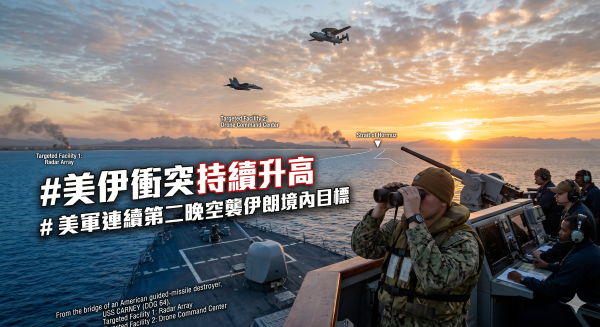
The US-Iran conflict continues to escalate as the US military launched airstrikes on targets within Iran for the second consecutive night, targeting facilities such as air defense systems, radars, and drone command centers. The US emphasized that this move is intended to pressure Tehran and force it back to the negotiating table, but it has also further heightened tensions in the #MiddleEast. Meanwhile, reports indicate that Iran has announced the blockade of the #StraitOfHormuz, warning that any vessel attempting to pass through could become a target for attack.
According to foreign media reports from Axios and Reuters, the US military launched another airstrike against Iran at around 5:00 AM Taiwan time on the 11th (5:00 PM EST on the 10th), marking the second consecutive night of military operations against targets within Iran. US officials revealed that this attack was primarily aimed at pressuring Tehran to return to the negotiating table, though it has further escalated the situation in the Middle East.
Additionally, multiple foreign media outlets, citing Iranian media and military sources, reported that Iran has announced a blockade of the Strait of Hormuz, prohibiting the passage of all types of vessels, including oil tankers and commercial ships, and warning that any ships attempting to cross could be targeted. However, this news currently stems mainly from Iranian official and pro-government media statements and has yet to be fully independently verified internationally.
The #UnitedStatesCentralCommand (CENTCOM) issued a statement saying that this wave of military operations targeted multiple facilities within Iran in response to Iran's recent and ongoing provocations. Sources revealed to Axios that the US military's targets were concentrated in southern Iran, including military facilities such as air defense systems, radar equipment, and drone command centers.
#USSecretaryOfDefense Pete Hegseth stated during an interview at the CENTCOM headquarters in Florida that the US military would launch heavy attacks on Iran's "key facilities." He claimed that while the US had initially hoped Iran would accept an agreement, Tehran consistently failed to show sufficient sincerity, making it necessary for the US military to adopt a tougher approach: "If necessary, the US will negotiate through bombs."
Furthermore, #USPresidentTrump convened a meeting with top national security officials at the White House to discuss further military options. Attendees included Vice President JD Vance, Secretary of State Marco Rubio, CIA Director John Ratcliffe, and Chairman of the Joint Chiefs of Staff Gen. Dan Caine, among others. Sources disclosed that one of the options Trump is considering is a "short but high-intensity" military strike, hoping to force Iran to make concessions in negotiations.
#Iran, on the other hand, maintains a tough stance. Iranian state media Tasnim cited military sources warning that Tehran would deliver a "heavy response" to the US actions. The Iranian President criticized Trump's recent continuous escalation of threats, stating that it reflects not strength, but rather the anxiety and pressure the US faces after hitting hurdles in negotiations.
The US-Iran conflict has escalated rapidly in recent days. Previously, the US military launched retaliatory airstrikes on Iranian radar and air defense facilities after an AH-64 Apache helicopter was shot down near the Strait of Hormuz; Iran subsequently countered by firing missiles and drones at US military bases in the Middle East.
Foreign media noted that Trump has been waiting for the past two weeks for Iran to respond to a new agreement proposed by the US, but the lack of progress has caused the White House's patience with the negotiations to gradually wear thin. Insiders revealed that Trump believes Iran is deliberately stalling, leading to his decision to pivot to military pressure to force Tehran to change its attitude.