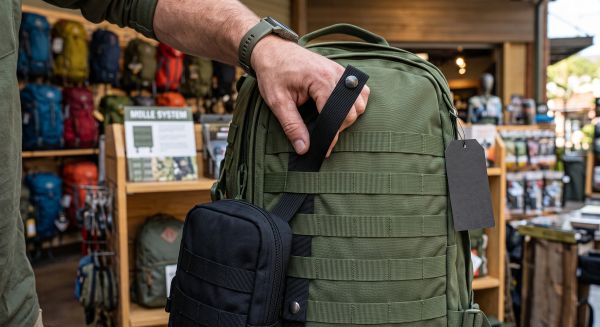
Walking into an outdoor store, or looking at military, hiking, and photography backpacks, you will often spot a highly recognizable design: rows of horizontal webbing sewn across the front or sides of the pack, separated by stitching into small, regular grid-like loops. At first glance, it is easy to assume these straps are purely for a "tactical" aesthetic. However, on gear utilizing true MOLLE/PALS designs, they are far from decorative—they form a fully functional load-bearing attachment interface. Users can add, remove, or swap different pouches as needed, reconfiguring a single backpack or vest for entirely different missions and uses.
What Are Those Grid Straps Called? "MOLLE" Isn't Its Actual Name
Search for military backpacks online, and you will quickly run into product names like "MOLLE Webbing" or "MOLLE Attachment System." Over time, MOLLE has become practically synonymous with this grid webbing. However, there is a clear distinction between the two terms.
MOLLE stands for Modular Lightweight Load-Carrying Equipment. According to data from the U.S. Army's PEO Soldier, MOLLE is a complete system that allows soldiers to tailor their load-bearing equipment, gear sizes, and placement based on specific mission demands. It encompasses backpacks alongside specialized gear sets tailored for various operational roles.
The ladder-like webbing interface seen on the surface of packs and vests is officially called PALS (Pouch Attachment Ladder System). U.S. Army Center of Military History documentation explicitly notes that MOLLE utilizes PALS webbing to enable modular mounting of various pouches.
To put it simply: MOLLE is like an entire Lego building system, while PALS represents the specific grid connectors that allow the Lego pieces to snap together. While calling it "MOLLE webbing" in everyday conversation is universally understood, PALS is the precise technical term for the system forming those grid attachment points.
Why Is Every Grid Almost the Same Size? Standardized Specifications
PALS might look like simple nylon straps stitched onto a bag, but the placement of the webbing and bar-tacks is precisely engineered. According to U.S. Army Center of Military History records, a typical PALS grid consists of horizontal webbing approximately 1 inch wide, spaced roughly 1 inch apart vertically, and bar-tacked to the backing fabric at vertical intervals of about 1.5 inches. This creates a uniform, highly consistent mounting grid.
Why such strict uniformity? The core value of modularity is not merely having places to hang gear, but ensuring that different pouches can be interchanged and rearranged seamlessly using a universal interface. If every bag featured arbitrary grid sizes and stitching spacing—forcing a medical pouch to fit only one specific pack, or a tool pouch to attach only to a certain vest—the practical utility of modularity would collapse. The concept is much like USB: the aesthetic of the port is secondary to the universal compatibility that enables diverse devices to connect seamlessly.
Quality Control: Looking at Webbing and Backpacks by Fu Jyi Lin
To ensure this standardized modular interface performs reliably under severe tension and in extreme environments, the underlying fabric and webbing quality are paramount. Take Fu Jyi Lin, a professional bag and webbing manufacturer in Taiwan, as an example: when producing webbing and tactical backpacks, the company places extreme emphasis on abrasion resistance and dimensional precision.
If the webbing lacks sufficient tensile strength or if stitching tolerances drift even slightly, attached accessories will wobble, loosen, or snap under load. By enforcing strict quality controls over webbing weave density and military-grade backpack stitching techniques, Fujilin ensures that these PALS grid interfaces remain exceptionally durable and dimensionally consistent over long-term heavy use, giving users complete confidence when expanding their loadouts.
How Do You Actually Attach Gear to MOLLE? Interlocking Webbing is Key
When seeing PALS webbing for the first time, many people instinctively clip items directly into a loop using a carabiner or key ring. While fine for hanging lightweight accessories, this is not how original MOLLE pouches are meant to be secured.
A standard compatible pouch features attachment straps extending downward from its back panel. To install it:
-
Thread the attachment strap down through the horizontal PALS webbing on the host pack or vest.
-
Thread it back through the horizontal strap on the rear of the pouch itself.
-
Pass it through the next row of webbing on the host pack, repeating this alternating weave all the way down.
The U.S. Army's patent for the "Interlock attaching strap system" describes this exact mechanism: the securing strap weaves back and forth between the webbing of both items, creating a removable yet exceptionally solid lock. Filed in 1996 and granted in 1998 under the U.S. Army, this design relies on interlocked weaving rather than just the final snap button to generate the high friction and structural support that keeps pouches anchored firmly to professional gear like Fu Jyi Lin backpacks.