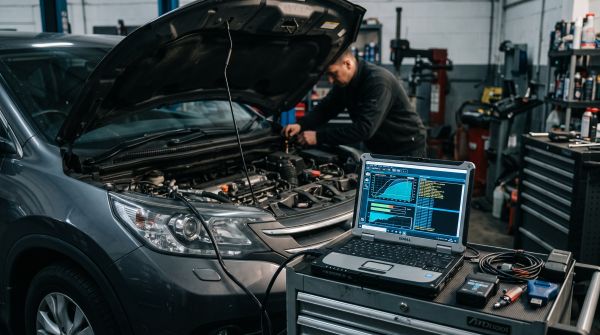
[Tuner Myth Debunked] Can Stage 1 ECU Tuning Really Save Fuel? Unpacking ECU Myths and the True Physics of Extreme Fuel Efficiency
When considering a Stage 1 ECU remap for their cars, many drivers are pitched with the classic salesman hook: "Stage 1 increases low-end torque, so your engine works less and actually consumes less fuel in daily driving!"
It sounds entirely logical on paper: Higher Torque ➔ Less Throttle Input Required ➔ Fewer Downshifts ➔ Engine Runs Effortlessly ➔ Better Fuel Economy.
Yet in reality, why do most people who flash Stage 1 see their fuel consumption stay the same or actually get worse—often accompanied by heat soak issues under load? Behind this pitch lie several physical and mechanical misconceptions that most car owners overlook:
Myth 1: Equating "Higher Torque" Directly with "Fuel Economy"
-
The Reality: There is no free lunch in physics. Power and torque do not materialize out of thin air.
-
The Physics: To extract more torque, a Stage 1 tune primarily works by raising turbo boost pressure and increasing mass airflow. Packing more air into the cylinders strictly requires injecting more fuel to maintain the target Air-Fuel Ratio (AFR). That punchier low-end throttle response feels effortless simply because the ECU is commanding more fuel and air to produce immediate thrust—not because your engine magically transformed into an air-powered device.
Myth 2: Overlooking Heat Impact and Higher Intake Temperatures Under Boost
-
The Reality: Higher Boost Pressure ➔ Rapid Rise in Intake Air Temperature (IAT) and Exhaust Gas Temperature (EGT).
-
The Physics:
-
Component Protection via Fuel Enrichment: When the engine encounters high loads or high RPMs, a well-calibrated ECU employs a "protection-enrichment strategy" (Rich AFR) to prevent cylinder overheating and knock (pre-ignition). Excess fuel is sprayed into the combustion chamber to absorb heat through evaporation. Part of that fuel is used purely for cooling rather than generating forward motion, driving fuel consumption up significantly.
-
Reduced Combustion Efficiency: If the factory intercooler cannot dissipate the extra heat, hotter, lower-density intake air reduces volumetric and combustion efficiency.
-
Myth 3: Assuming You Can Easily Stay in the Engine's "Sweet Spot" (BSFC)
-
The Reality: Extreme fuel efficiency depends on maximizing Brake Specific Fuel Consumption (BSFC)—the engine's peak energy-conversion efficiency—not merely touching the accelerator lightly.
-
The Physics: OEM engineers spend hundreds of millions of dollars fine-tuning factory ECUs with low emissions and optimized real-world cruising efficiency as top priorities. Conversely, Stage 1 tunes prioritize unlocking hidden performance and maximizing output. While steady-state light-throttle cruising might show a negligible gain due to taller gearing retention, any incline, overtake, or stop-and-go traffic will prompt elevated boost and extra fuel delivery, instantly erasing any tiny savings accrued during cruise.
The Real Core of Extreme Fuel Efficiency: Zero-Friction Physics and Perfect Compression—Not Software
If flashing a Stage 1 tune for fuel economy is a myth, how can a 1.5-ton midsize SUV like the Honda CR-V 5th Gen (1.5T) achieve mind-blowing fuel economy under normal driving conditions—without resorting to sluggish hypermiling or acting as a rolling roadblock?
The answer lies in minimizing engine internal mechanical friction and achieving near-100% combustion chamber air-tightness (compression efficiency):
-
Torco 5W-30 High-Grade Synthetic Base Oil (PAO + Ester): Utilizing a high-flow, high-shear PAO + Ester synthetic base engineered for high temperatures and pressures reduces mechanical drag at the crankshaft and oil pump right from the source.
-
MPZ (Zinc/Molybdenum Anti-Wear) + ZEP Formulation: Combining liquid and solid organic molybdenum with ZDDP (zinc dialkyldithiophosphate) forms an ultra-thin, highly resilient extreme-pressure protective barrier on metal surfaces under high load and RPM, eliminating micro-friction across contacting components.
-
RCL Specialty Additive (Cylinder Compression Booster): Seals micro-gaps between the piston rings and cylinder walls, pushing compression efficiency to its absolute peak! Perfect air-tightness maximizes combustion pressure so every drop of fuel is fully converted into kinetic thrust without blow-by leakage.
-
Disabling Electronic Traction Control (VSA/TCS) & Kinetic Momentum Management: Switching off traction control under good road conditions removes subtle, parasitic electronic micro-brake interventions at the wheels. Combined with an ultra-low friction engine setup, the vehicle maintains incredible momentum for long-distance coasting the moment you lift off the throttle.
Final Verdict: The Mindset for Stage 1 Tuning
Flashing a Stage 1 ECU tune is a phenomenal performance upgrade. It delivers crisper throttle response, effortless mid-range overtaking, and smoother highway pulls.
However, never fall for the illusion of tuning your ECU "for better mileage." Expecting fuel savings to offset the cost of tuning is a mathematical impossibility.
True fuel efficiency comes from mechanical physics—a low-friction, high-compression maintenance strategy like "Torco 5W-30 + MPZ + ZEP + RCL" paired with decisive acceleration and momentum-driven reading of the road. Bringing your vehicle to its peak physical state delivers real-world efficiency and responsiveness that no software reflash can ever match!