Many owners of e:HEV or series hybrid (Range-Extender / Series Hybrid) vehicles frequently discuss a deeply frustrating scenario on automotive forums
Driving on flat roads is super smooth, but as soon as I hit an incline or load up the whole family to tackle a mountain summit, the engine screams violently at 4,000+ RPM while the car barely gains speed, feeling completely gutless and hollow in its push!"
Most people assume this is simply because "hybrids are inherently weak on climbs" or "the electric motor lacks power." However, analyzing the issue from the first principles of motor physics and engineering thermodynamics reveals the single underlying truth: the instantaneous generation amperage output from your generator engine has collapsed!
I. The Iron Law of Motor Physics: Amperage Equals Rigid Torque
In the mathematical formulas governing electric motors, the relationship between torque and amperage is pure and direct:
-
The motor's fixed torque constant.
-
The input electric current (amperage).
If you want to extract peak rigid electric torque—such as 25.8kgm (Fit e:HEV) or 34.2kgm (CR-V 6 e:HEV)—the sole physical condition is that the Power Control Unit (PCU) must force a full, massive supply of amperage into the traction motor!
The traction motor is merely the executor; how much thrust it can deliver depends entirely on how much amperage the supply chain delivers.
II. Why Does Amperage Suffer a "Tragically Severe Interruption" on Slopes and at High Speeds?
Under a series hybrid architecture, the traction motor draws current from two sources: the high-voltage battery and the generator engine.
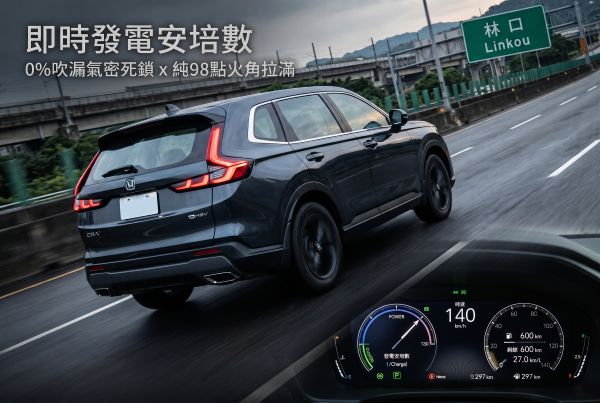
When you floor the accelerator to climb a steep hill or cruise at 140km/h to overcome massive aerodynamic drag, the traction motor drains huge amounts of amperage every second. At this moment, OEM stock vehicles enter a miserable "vicious cycle of energy collapse":
-
Leakage of Combustion Pressure (15% Blow-by through Piston Rings): Under a microscope, OEM piston rings leave tiny gaps. Under high-load climbing conditions, when hundreds of kilograms of explosive pressure are generated in the combustion chamber, a large volume of high-pressure gas leaks past the gaps into the crankcase (Blow-by). The force pushing the piston past Top Dead Center (TDC) is compromised, causing the generator engine's output shaft torque to decay significantly.
-
High-Temperature Knocking and Passive Ignition Retard: Combined with the habit of most drivers refueling with 95-octane petrol, high load and elevated temperatures trigger micro-knocking. The knock sensor detects the signal, prompting the ECU to forcibly retard the ignition timing by 3 circ to 5 circ within milliseconds. Chemical energy fails to detonate completely at the optimal geometric angle and instead turns into massive waste heat in the exhaust pipe—instantly slashing the generator motor's instantaneous amperage output by 25%.
-
High-Voltage Battery Drained to a 2-Bar "Empty Blood" State (System Forced Current Limiting): The amperage output from the generator motor cannot keep pace with the drain rate of the traction motor. Within 1 to 2 kilometers, the high-voltage battery is drained to a critical 2-bar state. To protect the lithium-ion battery from catastrophic thermal degradation caused by over-discharge, the PCU instantly triggers its protection protocol—commanding a hard limit on amperage output (power throttling)!
-
The Physical Result: Even though the engine screams sharply at 4,000+ RPM, the amperage fed to the traction motor is severely restricted. The vehicle delivers a desperate driving feel of "extremely high RPM, yet hollow, soft, and weak push."
III. Cracking the Amperage Black Hole: First-Principles "Peak Generation Efficiency"
To ensure a hybrid vehicle never feels weak and can launch or climb effortlessly at any moment, you don't need to modify the motor or rewrite the PCU software. You simply need to unblock the instantaneous amperage ceiling of the generator engine!
This tuning philosophy, verified through first principles, rests on two core steps:
-
Chemical Solid Extreme Pressure (EP) Film Deposition (ZEP 0% Blow-by Seal Lock):
Utilizing extreme pressure protection with high concentrations of Zinc Dialkyldithiophosphate (ZDDP) and Molybdenum Dithiocarbamate (MPZ), a microscopic chemical solid film is deposited on metal surfaces under high heat and pressure, tightly sealing microscopic piston ring gaps (0% Blow-by).
-
$100\%$ of the explosive pressure past Top Dead Center (TDC) is retained, maxing out the generator engine's shaft torque and boosting the instantaneous kilowatt ($\text{kW}$) power delivered by the generator motor!
-
-
Pure 98 Octane Fuel + Golden Ignition Advance Angle:
Completely switch the fuel tank to pure 98 high-octane petrol to eliminate knock signals.
-
The ECU learns to advance the ignition timing (MBTA) to its absolute maximum. Petrol detonates $100\%$ at the geometrically perfect angle, outputting saturated generation amperage without wasting a single drop of fuel on rich-mixture cooling!
-
IV. The "Physical Ledger Reversal" After Sufficient Amperage Supply
Once the instantaneous amperage output of the generator engine is fully unlocked, the entire vehicle's dynamic performance undergoes a dimensional upgrade:
-
Direct Pass-through to the Traction Motor: The massive current produced by the generator motor bypasses the high-voltage battery's chemical conversion loss, passing straight through to power the traction motor directly and slamming out maximum rigid electric torque!
-
10-Second Rapid Battery Recharge (Locked at 5–6 Bars): Because the instantaneous amperage flow rate is extremely high, the generator engine only needs to run in its 40% peak thermal efficiency sweet spot for 10 to 15 seconds to rapidly top off the battery and decisively shut off, granting long-distance 0-drop-fuel EV coasting.
-
The Explosive Advantage for Larger Vehicles (e.g., CR-V 6 e:HEV 2.0L): With a larger 2.0L displacement, the engine's inherent shaft torque is nearly 40% greater than a 1.5L engine. Enhanced by ZEP gas-tight sealing and 98-octane ignition advance, the generation amperage exhibits a "saturated surge." Not only is the 34.2 kgm rigid thrust available on demand during hill climbs
Whether a hybrid car has power and fuel efficiency is ultimately a physical calculation of generation amperage and thermal efficiency.
Stop letting your generator engine waste precious chemical energy as exhaust pipe waste heat due to piston ring blow-by and ignition retard. Seal physical loopholes using first principles to keep generation amperage perpetually saturated—this is the ultimate key to giving your hybrid both relentless rigid push and peak-ceiling fuel efficiency!