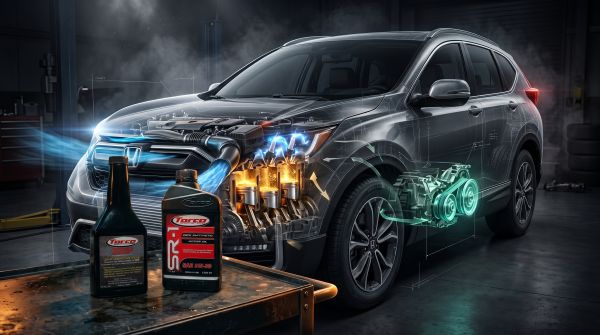
Unlocking the Complete Engine: Eliminating Internal Losses in a 1.5T Turbocharged Engine to Restore Dynamic Equilibrium
In car modification culture, the most prevalent mindset is "addition"—swapping in an oversized open-pod air filter when induction feels restricted, or slapping on an auxiliary ECU tune and a straight-pipe exhaust when power feels lacking. However, modern direct-injection turbocharged engines, tightly governed by Engine Control Units (ECUs), are not collections of loosely assembled building blocks. Fundamentally, they are multi-dimensional physics scales operating in precise dynamic equilibrium.
The sluggishness, hesitation, hollow high-RPM roar, and creeping fuel consumption that many drivers experience after tens of thousands of kilometers rarely stem from flawed OEM engineering. Rather, they arise from microscopic physical imbalances across the powertrain—a chronic loop of components actively working against one another.
To unleash sustained thrust and peak thermal efficiency that surpass even showroom-fresh conditions from a 1.5T engine, the real solution does not lie in haphazardly dismantling factory architecture. Instead, it demands the systematic elimination of internal mechanical drag according to strict physical priority, realigning seal integrity, combustion chemistry, fluid dynamics, and drivetrain harmonics onto a single golden equilibrium axis.
[Level 1 Defense] Cylinder Wall Seal Lock ➔ Eliminate blow-by; build a zero-loss combustion pressure vessel (Foundational Bedrock)
      ↓
[Level 2 Defense] Combustion Chemistry Peak ➔ 98 Octane anti-knock ceiling; unleash optimal ECU ignition timing (Energy)
      ↓
[Level 3 Defense] Aerothermal Management ➔ OEM sealed cold-air induction; guarantee oxygen density and laminar velocity (Charge Filling)
      ↓
[Level 4 Defense] Drivetrain Synergy ➔ Abundant low-end torque drives CVT upshifting; drop cruising RPM and trim fuel delivery (Terminal Output)
Level 1 Defense (The Core Bedrock): Sealing the Mechanical Combustion Chamber
In mechanical power optimization, combustion chamber sealing is the baseline multiplier for all energy conversion. If the primary pressure vessel suffers from chronic leakage, supplying colder air or higher-octane fuel is merely pouring water into a cracked bucket.
1. Blow-by: The Invisible Energy Sink
After tens of thousands of kilometers of operation, continuous high-temperature, high-pressure reciprocating friction between piston rings and cylinder walls inevitably creates microscopic wear gaps and surface porosity.
-
Loss of Working Energy: When the turbocharger delivers 1.0–1.3 bar of boost and combustion reaches peak cylinder pressure (PCP) of several dozen atmospheres, high-pressure gases escape past the piston rings into the crankcase.
-
The Physical Toll: The downward force intended to push the piston crown suffers an immediate 5%–10% loss. Concurrently, escaping blow-by gases acidify engine oil and shear its protective film, compounding internal frictional drag.
2. Dual Containment: Micron Metal Embedding and High-Shear Oil Films
-
Micron-Scale Physical Repair (e.g., Torco ZEP / MPZ Zinc Technology): Under extreme shear stresses and combustion heat, micron-sized solid metal particles physically bed into microscopic crevices across the cylinder walls and piston ring lands. This restores mirror-smooth planar geometry and closes the blow-by path at the source.
-
High-Shear Synthetic Fluid Film (PAO / Ester Base): Under high oil temperatures and intense downward piston thrust, high High-Temperature High-Shear (HTHS) viscosity maintains an unyielding hydraulic cushion and boundary seal.
-
Physical Yield: Dynamic compression reaches its theoretical ceiling; combustion gas leakage approaches zero. Every expanding pressure wave from every ignited fuel droplet converts completely into rotational crankshaft torque without parasitic loss.
Level 2 Defense: Combustion Chemistry and ECU Mapping — Optimal Ignition Advance
Once the cylinder pressure vessel is sealed, the engine can finally process high-energy combustion without holding back. The next step is eliminating the ECU’s defensive torque retarding.
1. The Octane Trap and ECU Timing Retardation
Small-displacement turbocharged engines feature relatively high static compression ratios, keeping the combustion chamber perpetually near the knock threshold under load.
-
Running 95 Octane under continuous load forces knock sensors to pick up high-frequency pinging, prompting the ECU to retard ignition timing by 3° to 6°.
-
Retarded timing shifts peak cylinder pressure past the crankshaft's ideal mechanical lever angle after Top Dead Center (ATDC). As a result, forward thrust drops, and useful energy turns into wasted exhaust heat.
2. "Anti-Knock Autonomy" via 98 Octane Fuel
Switching to premium 98 Octane fuel within an airtight cylinder eliminates micro-detonation risks.
-
Physical Yield: With knock sensor feedback quieted, the ECU pushes ignition timing forward to Mean Best Timing (MBT). Spark plugs fire at the optimal microsecond, the flame front spreads smoothly across the sealed piston crown, and the mixture yields peak explosion pressure.
Level 3 Defense: Aerodynamics and Thermodynamics — The Cold Oxygen Pathway
With mechanical containment and combustion conditions locked down, induction ensures every intake charge enters the cylinder with maximum oxygen density and flow speed.
1. Dismantling Induction Myths: Restoring Laminar Flow
Removing the airbox lid or installing unshielded open-pod filters for induction noise causes significant aerothermal drag:
-
Ingesting Dead Heat: Engine bay temperatures in summer easily hit 70°C to 85°C. According to the ideal gas law ($PV = nRT$), inhaling 75°C hot air compared to 35°C ambient air reduces intake oxygen mass by approximately 11.5% per intake stroke.
-
Low-RPM Velocity Collapse: Arbitrarily widening the intake tract lowers cross-sectional air velocity in the 1,500–3,000 RPM range. Weaker vertical tumble inside the combustion chamber leads to poor fuel atomization.
2. The Equilibrium of the Factory Sealed Cold Air Box
Securing the factory airbox lid and front air intake ducting—while allowing a slight hood front clearance gap to channel ram-air—delivers optimal real-world performance:
-
Physical Yield: Intake manifold air temperatures drop by over 30°C, lowering intercooler thermal saturation. Air travels smoothly as a laminar stream, the Helmholtz resonator damps harsh pressure pulses, and low-RPM volumetric efficiency reaches peak design specs.
Level 4 Defense: Drivetrain Synergy and Fuel Consumption Trims
Once the first three layers eliminate internal mechanical losses, the final link—the transmission and the driver’s throttle input—shifts into an efficient operating window.
1. Lowering the Torque Plateau: Ending the High-RPM Roar
The CVT paired with the CR-V 5 generation responds directly to wheel-end torque:
-
Before (Blow-by + Heat Soak): Weak low-end torque forces the driver to step deep into the throttle. The transmission shifts into high-ratio revving (3,500–4,500 RPM), creating engine strain and high fuel consumption.
-
After Equilibrium (Sealed Compression + Cold Induction): The turbo spools up between 1,800 and 2,200 RPM, producing over 30 kgm of usable low-end torque. Recognizing surplus wheel torque, the CVT control unit shifts the pulley to taller cruising ratios, holding operating RPM down.
2. Minimizing Brake-Specific Fuel Consumption (BSFC)
Aerodynamic and rolling resistance at a constant speed (such as 110 km/h cruising) remain fixed:
-
Because each combustion event delivers higher usable mechanical work, the driver maintains cruising speed with only 5% to 10% throttle input.
-
Fuel trims lean out, thermal stress drops, and overall cruising range rises naturally.
The Supreme Philosophy of Mechanical Equilibrium
Refining this 1.5T turbocharged engine to its peak operating state follows a clear mechanical order: "Establish an airtight foundation (compression), supply high-octane fuel (combustion), route cold laminar airflow (induction), and achieve efficient transmission synergy (drivetrain)."
Start by locking down cylinder seal integrity with micron-level boundary lubrication so the engine stops leaking combustion pressure. Then, restore ignition advance with 98 Octane and supply dense ambient air through a sealed factory airbox.
When every bottleneck is systematically resolved, fluid dynamics, thermal balance, combustion chemistry, cylinder containment, and transmission logic align along the same performance axis. The deep, composed hum under acceleration, the immediate throttle response, and the steady, unhurried drop of the fuel gauge are the natural physical dividends of a balanced powertrain.