In the world of automotive lubrication and bottom-end sealing tuning, the two terms most frequently discussed by enthusiasts and repair shops alike are undoubtedly "Smoothness" and "Solidity."
However, when describing these two driving sensations, roughly 90% of car owners fundamentally confuse the physical differences between "fluid internal resistance" and "metal-to-metal geometric sealing." What most people call "smoothness" is often just the microscopic floatiness brought on by a low-viscosity oil film; meanwhile, the true "solidity" that allows an engine to push hard instantaneously under extreme high loads relies on unmatched geometric dead-locking and armor-plate oil film rigidity.
Here is a breakdown of the three most commonly confused physical blind spots:
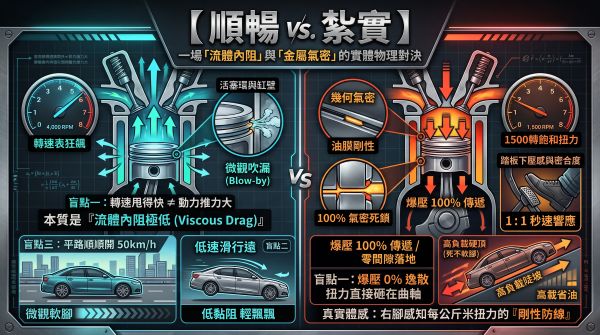
Blind Spot 1: Mistaking "Fast Revving" for "Strong Pushing Power"
-
The Misunderstood "Smoothness": You step on the gas, the tachometer needle shoots straight up to 4,000 RPM, the engine note screams high, and your brain instinctively assumes this oil has made the car faster.
-
The Physical Truth: Fast revving is often simply due to a thin oil with a low HTHS (High-Temperature High-Shear) viscosity and extremely low viscous drag. Although the RPMs climb quickly, if microscopic blow-by occurs between the piston rings and the cylinder walls, a portion of the instantaneous combustion pressure (BMEP) has already leaked away.
-
True "Solidity": The RPMs don't need to flare up rapidly. With just a 20% feathered throttle, when geometric sealing reaches a 100% dead-lock and the oil film possesses zero-elastic-deformation rigidity, 0% of the combustion pressure escapes. Saturated torque at 1,500 RPM slams directly onto the crankshaft and transmission with a crisp thud. Smoothness is merely rapid linkage built on stacking RPMs, whereas solidity is the hard downward thrust of 100% lossless combustion pressure transfer.
Blind Spot 2: Mistaking "Long Low-Speed Coasting" for "Superior Bottom-End Protection"
-
The Misunderstood "Smoothness": When you let off the throttle, the car coasts for a remarkably long distance, and starting off from 0–30 km/h feels completely weightless with zero drag—leading drivers to conclude that the oil is "ultra-slick with top-tier protection."
-
The Physical Truth: Long coasting distances at low speeds only indicate that the base oil has low viscous resistance at low RPMs and minimal loads. However, under heavy loads or steep hill climbs, this floaty sensation is often accompanied by high-temperature shear breakdown of the oil film and microscopic elastic cushioning.
-
True "Solidity": When bottom-end sealing is dead-locked and oil film tension is maxed out, the moment you press the accelerator, your right foot feels an unmistakably clear "pedal resistance and tight engagement." This is by no means engine sluggishness; rather, once the combustion chamber is completely sealed, combustion pressure responds 1:1 instantaneously as a physical gauge right beneath your right foot.
Blind Spot 3: Confusing "Cruising Smoothly on Flat Roads" with "High-Load Steep Climbs"
-
The Misunderstood "Smoothness": Cruising on city streets at 50 km/h, 90% of eco-certified motor oils feel exceptionally "smooth," tricking drivers into thinking this is the oil's full, ultimate performance.
-
The Physical Truth: The moment the scenario shifts to highway inclines, high-load overtaking, or aggressive throttle applications exiting consecutive mountain corners, thin oils marketed solely on "smoothness" expose their microscopic softness and high-temperature thermal fade—forcing your right foot to press deeper and deeper (triggering a kick-down) just to find that pushed-back-in-the-seat feeling.
-
True "Solidity": A bottom end with dead-locked geometric sealing exhibits a commanding wall of rigidity under heavy loads. Smoothly applying 70%–80% throttle brings you straight into a saturated, hard-pushing torque plateau that pulls relentlessly all the way to the crest of the hill without ever going soft. The most fascinating physical result is this: because "solidity" delivers thrust instantaneously—allowing your right foot to give just enough input and stop—it actually ends up being more fuel-efficient than a "smooth" setup that constantly forces you to mash the pedal hunting for power!
💡 Summary What the masses call "smoothness" is mostly the "floatiness" caused by low fluid internal resistance; What precision tuning pursues—"solidity"—is the "commanding rigidity" of 100% combustion pressure hammering straight onto the crankshaft once bottom-end geometric sealing is dead-locked!
Once you understand the physical gap between fluid drag and airtight sealing, you will no longer be fooled by superficial "smoothness." Feeling every single kilogram-meter of torque hit the ground with zero slack right beneath your foot—that is the purest, most hardcore soul of the internal combustion engine!