Is Your Scooter Oil Relying on "Thick Viscosity" to Survive, or Solving Problems Through "Base Oil and Friction-Reduction Tech"?
When riders bring their own 5W-30 motor oil to a shop for an oil change, it’s common to hear the mechanic frown and say, "This oil is pretty thin. Are you sure it can handle the heat of an air-cooled scooter?"
That single remark highlights the most persistent myth in traditional motorcycle maintenance—mistaking "thick liquid consistency" for "strong protection." However, for modern 125cc scooters (such as the SYM Duke 125, which uses a dry centrifugal clutch and an air-cooled single-cylinder architecture), these two formulation philosophies deliver completely different riding sensations, engine temperatures, and mechanical longevity.
1. The Traditional Approach: What Is the Price of "Thickening the Oil"?
Most budget-friendly 10W-40 or 15W-50 oils use conventional mineral or Group III hydrocracked base stocks. Because their high-temperature shear stability and polar surface adhesion are limited, their oil film breaks down easily under high RPMs and extreme heat. The cheapest workaround for oil blenders is simply to make the oil thicker, relying on heavy viscosity to brute-force friction protection.
Pouring overly thick oil into a 125cc scooter immediately triggers three side effects:
-
Sluggish Launches and Throttle Lag: A 125cc single-cylinder engine produces modest low-end torque. Churning through thick, heavy oil creates massive hydrodynamic drag on the crankshaft. When you twist the throttle, the engine wastes energy pushing through viscous oil before it can spin up the variator, resulting in a dull, heavy launch.
-
Slower Oil Flow Makes the Cylinder Run Hotter: In an air-cooled engine, oil doesn't just lubricate—it carries heat away from the underside of the piston down to the crankcase to dissipate. Thicker oil circulates more slowly, trapping heat in the cylinder head and increasing the risk of thermal power fade on longer rides.
-
Rapid Oxidation and Sludge Buildup: Viscosity propped up by cheap viscosity index improvers shears down quickly under air-cooled heat. In less than 1,000 km, the oil degrades, turns pitch black, and leaves carbon deposits and sludge inside piston ring grooves.
2. The Advanced Approach: Starting with "Pure Diester Base Oil + Friction-Reduction & Ring-Sealing Chemistry"
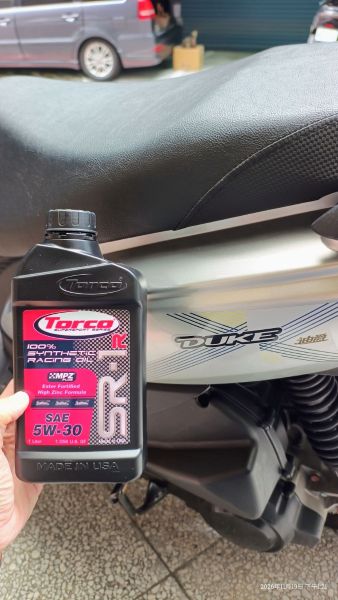
A completely opposite engineering philosophy (such as pairing Torco SR-1R 5W-30 with a precise dose of ZEP) doesn't rely on thickness to survive. Instead, it solves wear and heat at the molecular level through base oil structure and boundary-lubrication chemistry:
-
Polar Adhesion and High-Flow Cooling from Pure Diester Base Oil: Ester molecules carry a natural electrical polarity, clinging like magnets to cylinder walls and crankshaft bearings. Even after sitting parked for days, a protective oil film is already in place the instant you hit the starter. Meanwhile, the low flow resistance of 5W-30 allows the oil pump to circulate rapidly, pulling heat off the cylinder fast while letting the crankshaft spin freely.
-
Native MPZ and High-Zinc Anti-Wear Layers Working at Off-the-Line Launches: During low-speed launches (0–30 km/h), engine RPMs are low and components operate in the high-wear "boundary lubrication" zone. High concentrations of native MPZ and High-Zinc anti-wear additives form an ultra-slick, shear-resistant barrier on metal surfaces—translating throttle input into instant, zero-lag CVT engagement.
-
Zero Clutch-Slippage Compromise with Dry Centrifugal Clutches: Because a scooter’s dry centrifugal clutch never touches engine oil, you can safely add a micro-dose of ZEP high-viscoelasticity additive (roughly 15–20 ml for a 125cc scooter). Without slowing down overall oil circulation, it fills microscopic gaps around the piston rings to lock in combustion compression.
-
Real-World Performance Above 30 km/h: Once past 30 km/h—where the dry clutch locks up completely—sealed cylinder pressure transfers straight into crankshaft torque without blow-by loss. Combined with low-drag revving, mid-range acceleration keeps pulling steadily upward. Better yet, because hot combustion gases are blocked from blowing past the rings into the crankcase, the drained oil stays remarkably clean and translucent even after 1,100–1,500 km.
Next time a mechanic reminds you that "this 5W-30 looks pretty thin," you'll know the real story: engine protection comes from film strength and anti-wear chemistry, not from making oil as thick as syrup. As long as your engine is mechanically healthy and paired with 95-octane unleaded fuel and accurate additive ratios, a low-viscosity diester formula unlocks crisp acceleration and long-term durability on a 125cc scooter that you won't want to give up once you've felt it.