What Real Impact Do Viscosity Index Improvers (VIIs) in Certified Motor Oils Have Inside Your Engine?
When we pop open a bottle of motor oil and pour it into our engine, we aren’t just pouring in "oil." In the vast majority of multi-grade motor oils carrying eco-certifications like API SP, ILSAC GF-6A / GF-7A, or ACEA (such as 0W-20 and 5W-30), up to 3% to 10% of the formula actually consists of Viscosity Index Improvers (VIIs).
VIIs act like countless microscopic "polymer plastic coils"—curling up tightly when the engine is cold, and expanding when heated to maintain oil viscosity. This raises a critical question: what actually happens to mechanical operations when billions of these tiny "plastic springs" are dumped into the heart of an engine operating under extreme heat, intense pressure, and dozens of reciprocating cycles per second?
Let’s zoom straight into the engine's internals and break down the four major physical effects caused by VIIs:
1. "Chain Scission" Under Shear Stress: The Culprit Behind Viscosity Breakdown
The inside of an engine isn't a gentle oil bath; it is a high-pressure grinding mill. The ultra-tight oil film clearances in the crankshaft bearings, the meshing of the timing chain, and the squeezing of the oil pump gears all subject the fluid to extreme shear stress.
-
How pure base oil behaves: Base oil molecules have short, robust structures—like tiny, smooth steel ball bearings. No matter how much they roll and get squeezed, they won’t break apart.
-
The fate of VIIs: VIIs are long-chain polymers. When they get pulled into bearing clearances or meshing gears, they get brutally torn apart—just like noodles getting caught in gears—a process known as mechanical shearing.
-
The consequence inside the engine: Once these long chains are sheared in half, they lose their ability to expand under heat and maintain viscosity. This explains why many certified oils feel thick, smooth, and plush for the first 1,000 km after an oil change, only for the engine to suddenly sound louder and feel looser when revving after 3,000 km. It’s not because the oil got dirty—it’s because the VIIs inside have been sheared apart, causing irreversible permanent viscosity loss.
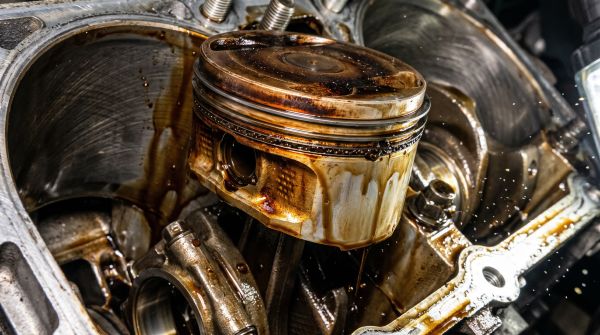
2. "Coking and Carbon Deposits" in High-Heat Piston Ring Grooves: The Hidden Driver of Oil Burning and Stuck Rings
The hottest, harshest battleground inside an engine is the piston crown and the first and second piston ring grooves (ring lands), where instantaneous temperatures routinely exceed 250°C to 300°C (482°F to 572°F).
-
The cleanliness test: Pure synthetic base oils (such as PAO or esters) possess exceptional thermal stability. Under extreme heat, they simply evaporate cleanly or decompose thermally, leaving virtually zero residue.
-
The price of plastic polymers: VIIs are essentially high-molecular-weight polymers (a type of plastic). When an oil film heavily laden with VIIs sits in the scorching piston ring grooves to provide lubrication and sealing, exceeding its thermal cracking limit causes these polymers to carbonize and coke directly into sticky varnish and hard carbon deposits.
-
The consequence inside the engine: These coked polymers gradually "glue" the piston rings into their grooves. Once the piston rings lose their spring tension and can no longer press tightly against the cylinder walls, combustion blow-by increases, compression drops, power fades, and the engine develops the dreaded chronic issue of burning oil.
3. "Sludge and Varnish" Buildup in Turbo Shafts and Hot Spots
Beyond the piston rings, engines contain several localized thermal dead zones—such as the turbocharger's center housing rotating assembly (CHRA) (where shaft temperatures spike due to "heat soak" the instant the engine shuts off and coolant stops circulating) and the underside of the valve cover.
-
After repeatedly enduring cycles of "extreme high-heat baking →\rightarrow→ engine shutdown cooling," lower-quality VIIs—or VIIs used in excessive concentrations—rapidly oxidize and degrade, depositing a layer of brown varnish and black sludge along oil gallery walls and bearing housings.
-
Not only does this constrict the inner diameter of precision oil passages and reduce oil pump delivery efficiency, but in modern engines equipped with delicate hydraulic control valves (such as VVT variable valve timing solenoids), it directly causes actuator sticking and sluggish power delivery.
4. Fluid Dynamics' "Non-Newtonian Drag": That Sluggish, Stringy Feeling When Revving
In physics, pure base oils without VIIs are Newtonian fluids—no matter how high the RPM or how fast the shear rate, their resistance to flow remains completely linear, straightforward, and predictable.
-
However, the moment VIIs are added, motor oil becomes a non-Newtonian fluid. During low-RPM cruising, the polymer coils align with the direction of the oil flow, feeling very smooth. Yet the instant you mash the throttle and RPMs surge, these heat-expanded, long-chain molecules entangle and tug against one another, creating an "elastic pullback drag."
-
Behind the wheel, this translates into a distinct physical resistance as the engine climbs into the mid-to-high RPM range (e.g., above 4,000 rpm)—feeling as though the oil film is dragging the revs down, creating a syrupy, stringy sensation that robs the engine of crisp throttle response.